Middle Eastern Ice Cream: A Guide From Bastani to Booza
· 6 min read
Middle Eastern ice cream isn't one dessert but a family of them, from Iran's saffron bastani and Turkey's stretchy dondurma to Syria's pounded booza and Afghanistan's cardamom shir yakh. What links most of them is a short list of ingredients the region has loved for centuries (salep, mastic, rosewater, pistachio, saffron, cardamom) and a texture that's denser and chewier than a Western scoop.
Here's a guide to the main types of Middle Eastern ice cream, country by country: what each one is, what goes into it, and how it eats. If you're after the backstory of ice houses, snow and sherbet, that's in our history of ice cream in the Middle East.
The two ingredients behind the stretch
Before the countries, two ingredients explain a lot of what makes these ice creams different.
Salep (sahlab in Arabic) is a flour ground from the dried tubers of wild orchids. Its main component is glucomannan, a long-chain sugar that holds on to water, and it's the traditional thickener in Turkish ice cream.1 It makes ice cream thick, elastic and slow to melt.
Mastic is a resin from the mastic tree, grown and harvested in the villages of southern Chios, a Greek island.2 A little of it adds a resinous flavor and extra chew.
On top of that sits the flavor layer: rosewater and orange blossom water, pistachios, saffron and cardamom. Not every ice cream below uses all of them, but you'll meet each one more than once.
Iran: bastani sonnati and faloodeh
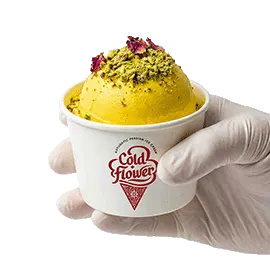
Bastani sonnati is Iran's traditional ice cream: a rich, golden ice cream flavored with saffron and rosewater, full of pistachios, and often studded with flakes of frozen cream. Recipes that use salep give it a gentle chew. We've written a whole post on it, so for the details see what is bastani sonnati. Our own Bastani Sonnati is made with saffron threads, crunchy pistachios and frozen clotted cream.
Faloodeh is the other half of a classic Persian ice cream order, and it's closer to a sorbet. Thin noodles made from rice starch are frozen in a rosewater syrup until icy, then served with a squeeze of lime or a spoonful of sour cherry syrup. It's associated with the city of Shiraz, which is why it's often called faloodeh Shirazi, and in Iran it's commonly eaten next to a scoop of bastani.3
The texture is the point: crisp, cold strands and sharp citrus against creamy saffron ice cream. Don't confuse it with South Asian falooda, a related but different dessert drink.
Turkey: dondurma, the ice cream you can stretch
Dondurma is the Turkish word for ice cream, but the famous stretchy kind is Maraş dondurması, named for the city of Kahramanmaraş in southern Turkey. It's made from goat's milk, sugar, salep and mastic, and it comes out thick, chewy and slow to melt. It's firm enough that street vendors famously tease customers, pulling the cone away again and again before handing it over.
Why does it stretch? Both key ingredients contain polymers, long molecules made of repeating units: glucomannan in salep, and a resin polymer in mastic. Those long chains are the likely source of the elastic pull.
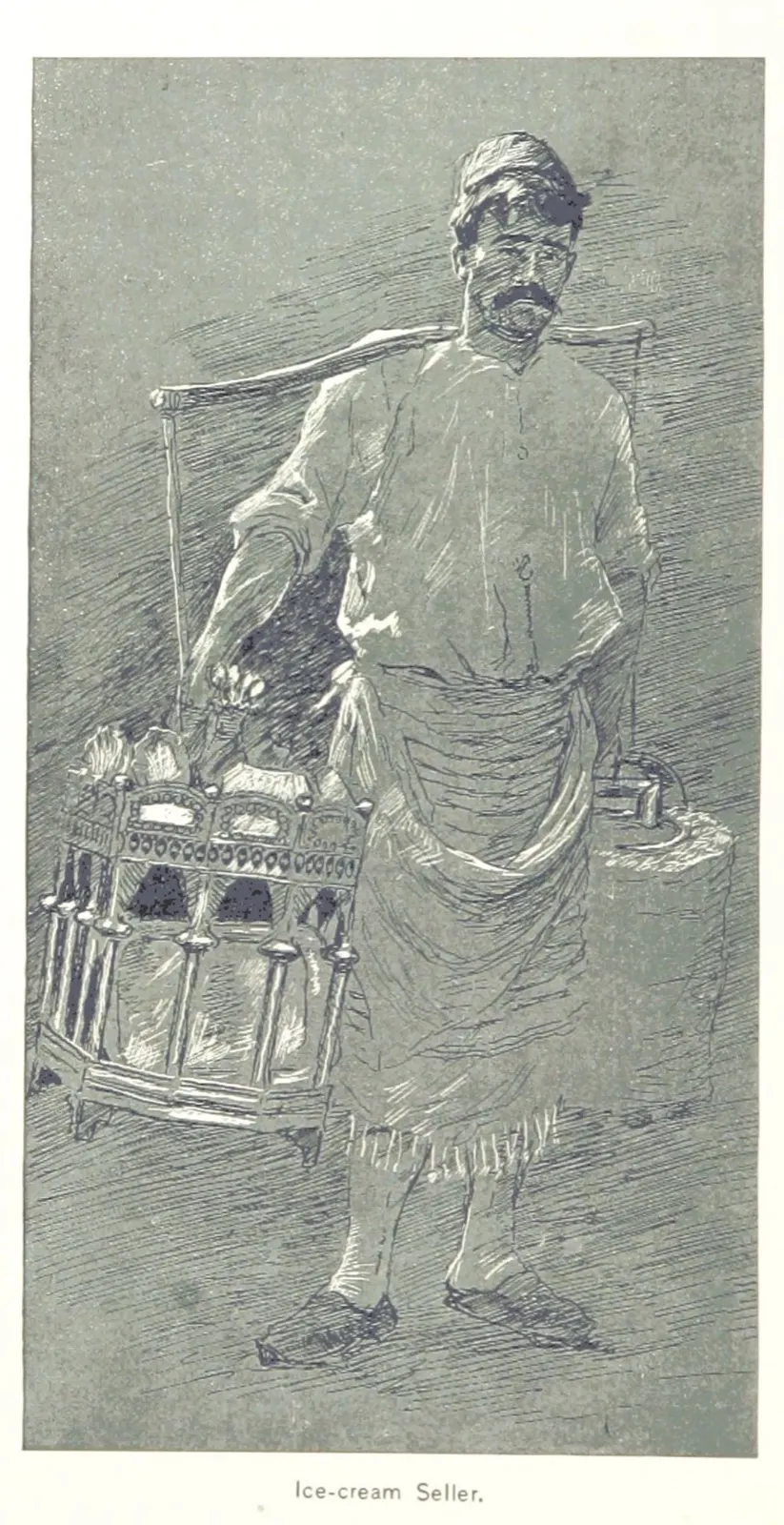
Ice-cream seller in Constantinople, by Edward L. Weeks, from F. Marion Crawford's book "Constantinople", 1895. Public domain, via Wikimedia Commons.
Syria and Lebanon: booza, pounded with pistachios
Booza is the Levant's stretchy ice cream and dondurma's close cousin. It's built on milk and cream thickened with sahlab and flavored with mastic. Instead of being churned, it's pounded with long wooden pestles in a chilled drum and pulled by hand, which presses out air and leaves it dense and taffy-like.4
In Damascus it has been made this way since at least the late nineteenth century, and the classic serving is a slab of white booza rolled in crushed pistachios.
Ashta: the cream flavor
Ashta (also qashta) is Arabic clotted cream: the thick layer that forms on simmered milk, often scented with rosewater or orange blossom water. It's the filling in many Levantine pastries, and it's one of the classic flavors of booza. A scoop of ashta ice cream is milky, floral and plain in the best way, and it's often finished with pistachios.
Clotted cream turns up in Persian ice cream too, frozen into flakes and folded through bastani. It's what gives our Bastani Sonnati its cold, buttery pieces.
Afghanistan: shir yakh
Shir yakh puts the Persian words for milk (shir) and ice (yakh) together, and it's Afghanistan's traditional ice cream: milk and sugar flavored with cardamom, and sometimes with rosewater and pistachios. In Afghan cities it was sold through the hot months at dedicated shir yakh shops.5
The traditional method is all hand work. The mix goes into a metal drum set inside a larger tub of ice and salt, and the maker turns the drum and scrapes the freezing milk off its cold walls until it thickens. The result is light, clean and fragrant rather than rich. Our Shir Yakh keeps it simple too: milk, sugar and cardamom. There's more on its past in our post on the history of ice cream in Afghanistan.
The Gulf: saffron, cardamom and dates
The Gulf doesn't have one classic ice cream the way Damascus has booza. What it has is a strong set of dessert flavors, and the region's ice cream makers have been turning them into scoops.
Start with luqaimat, the Emirati favorite: small balls of yeasted dough, fried and drizzled with date syrup, with saffron and cardamom in the batter. Dates themselves are close to the heart of Gulf food. UNESCO lists the date palm as shared heritage of fifteen Arab countries, calling it "a key source of nutrition."6
Gulf ice cream makers now turn these into scoops: saffron, cardamom, dates, even luqaimat. Saffron is the thread that runs from the Gulf back to Iran. It deserves a post of its own, but our Saffron ice cream (saffron-infused cream with hints of rosewater) is the simplest way to taste it.
Middle Eastern ice cream at a glance
| Type | Where it's from | Key ingredients | Texture |
|---|---|---|---|
| Bastani sonnati | Iran | Saffron, rosewater, pistachio, frozen cream | Rich, dense, a little chewy |
| Faloodeh | Iran (Shiraz) | Rice-starch noodles, rosewater syrup, lime | Icy, crisp, sorbet-like |
| Dondurma | Turkey (Kahramanmaraş) | Goat's milk, salep, mastic | Thick, very stretchy, slow to melt |
| Booza | Syria, Lebanon | Milk, cream, sahlab, mastic, pistachio | Pounded, dense, taffy-like |
| Ashta | The Levant | Clotted cream, rose or orange blossom | Creamy, milky, floral |
| Shir yakh | Afghanistan | Milk, sugar, cardamom, often rosewater | Light and clean |
| Gulf flavors | UAE and the Gulf | Saffron, cardamom, dates, luqaimat | Varies by maker |
Finding Middle Eastern ice cream in New York
Most of these are easy to find in Tehran, Istanbul or Damascus and surprisingly hard to find in New York. That's why Cold Flower exists: we're two brothers, born and raised in New York, who couldn't find real Persian and Afghan ice cream in the city, so we learned to make it ourselves.
We make our Persian and Afghan classics, and our Middle Eastern-inspired flavors, in small weekly batches, and every pint is 100% Halal. See what's in this week's batch, then order for delivery across NYC and Long Island, or choose pickup in the East Village at checkout. Planning a wedding, Eid party or office event? We bring the ice cream to you with our ice cream cart catering.
Frequently asked questions
Why is Middle Eastern ice cream stretchy?
Mostly because of salep, a flour made from dried orchid tubers. Its main component, glucomannan, binds water into long chains that make the ice cream thick and elastic. Many recipes add mastic resin too, and booza is also pounded by hand, which pushes out air and makes it denser.
What is the difference between booza and dondurma?
They are close cousins. Both are stretchy ice creams thickened with salep and mastic. Dondurma is the Turkish version, tied to Kahramanmaraş and traditionally made with goat's milk. Booza is the Syrian and Lebanese version, pounded with wooden pestles and often rolled in pistachios.
What is Arabic ice cream made of?
Classic Arabic ice cream, or booza, is milk, cream and sugar thickened with sahlab (salep) and flavored with mastic. A classic flavor is ashta, or qashta, a clotted-cream flavor often finished with crushed pistachios. Rosewater and orange blossom water are common too.
Is Middle Eastern ice cream halal?
The traditional ingredients (milk, cream, sugar, salep, mastic, rosewater, nuts and spices) contain nothing haram, but commercial recipes can add gelatin or alcohol-based flavorings, so check with the maker. Every Cold Flower pint is made with 100% Halal ingredients.
Where can I get Middle Eastern ice cream in NYC?
Cold Flower makes Persian and Afghan ice cream, along with Middle Eastern-inspired flavors, in small weekly batches. Order online for delivery across NYC and Long Island, or pick up in the East Village.
Taste it for yourself
Every pint is handmade in small batches with 100% Halal ingredients. When a batch sells out, it's gone until the next one.
Baklava
Yemeni Coffee
Bastani Sonnati
Sources
-
N. Develi Işıklı et al., "Rheological Properties of Salep Powder–Milk Mixture," Journal of Food Science and Technology 52, no. 10 (2015): 6556–64, https://pmc.ncbi.nlm.nih.gov/articles/PMC4573114/. ↩
-
UNESCO, "Know-How of Cultivating Mastic on the Island of Chios," Intangible Cultural Heritage, https://ich.unesco.org/en/RL/00993. ↩
-
"Faloodeh Shirazi," Farhang Flavor, Farhang Foundation, https://farhang.org/farhang-flavor/faloodeh-shirazi. ↩
-
Michael Jansen, "Ice Cream Keeps Syrians Cool over 120 Years of Turbulent History," Irish Times, 2015, https://www.irishtimes.com/news/world/middle-east/ice-cream-keeps-syrians-cool-over-120-years-of-turbulent-history-1.2143164. ↩
-
Durkhanai Ayubi, "Flavors: Shir Yakheh Gulab (Rose and Pistachio Ice Cream)," AramcoWorld, 2023, https://www.aramcoworld.com/en/articles/2023/flavors-shir-yakheh-gulab-rose-and-pistachio-ice-cream. ↩
-
UNESCO, "Date Palm, Knowledge, Skills, Traditions and Practices," Intangible Cultural Heritage, https://ich.unesco.org/en/RL/date-palm-knowledge-skills-traditions-and-practices-01509. ↩