Afghan Ice Cream: A History of Shir Yakh, From Snow to Scoop
· 5 min read
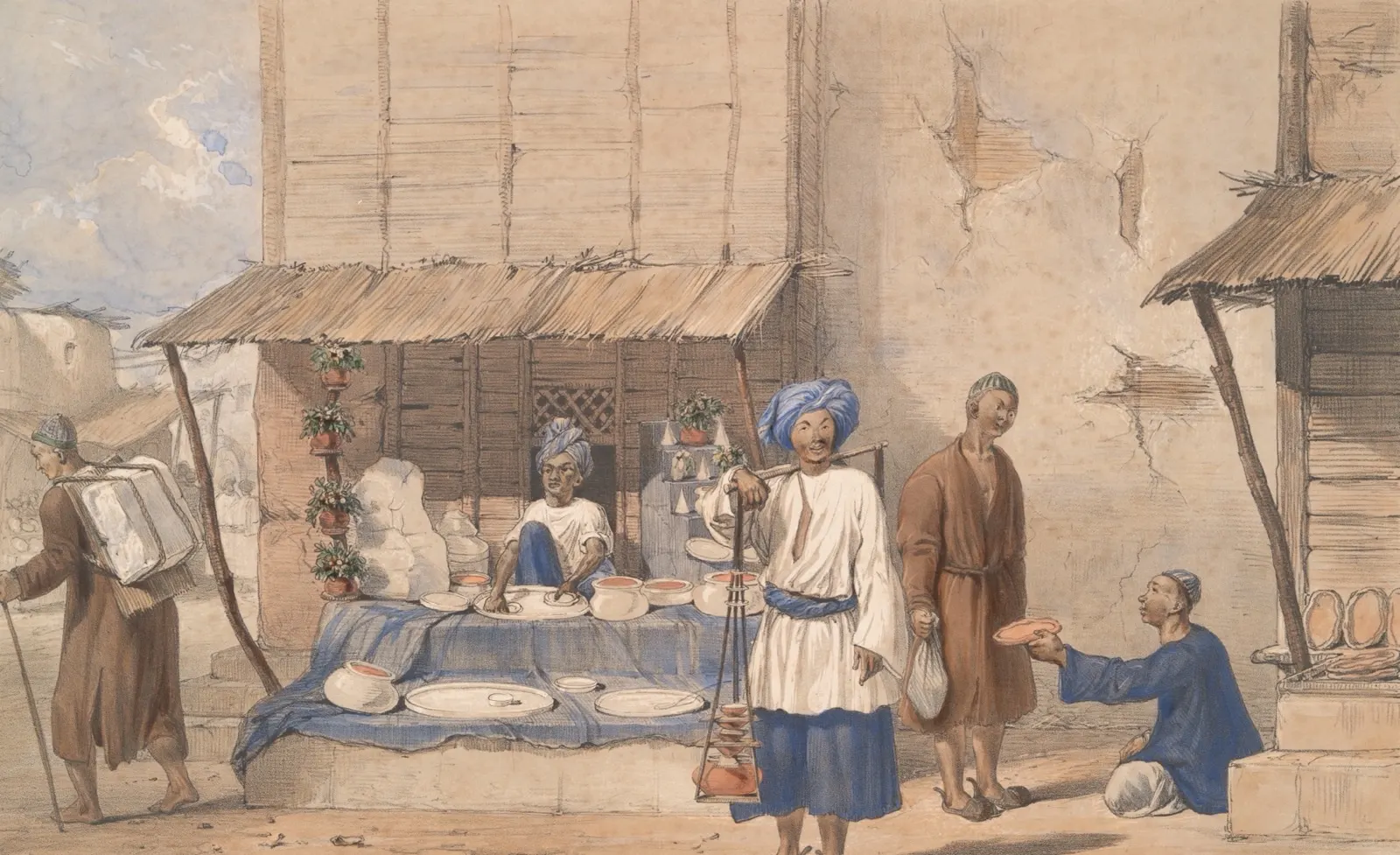
Cabul: a fulloodeh stall, with Huzzareh's carrying snow, &c., to market. Lithograph by Charles Haghe, from Lockyer Willis Hart's Character and Costume of Afghaunistan, 1843. Public domain, via the New York Public Library and Wikimedia Commons.
Afghan ice cream is called shir yakh: milk, sugar and usually cardamom or rosewater, churned by hand in a metal drum set in ice until it turns thick, cold and slightly stretchy. Its history in Afghanistan is really a history of ice: of snow carried down from the mountains around Kabul, stored through the summer, and sold in the bazaar alongside faloodeh and other cold sweets.
Here's how Afghans kept cool before refrigeration, how shir yakh is made, and where it has traveled since.
What is Afghan ice cream?
The name says most of it. In Dari, as in Persian, shir is milk and yakh is ice,1 so shir yakh is simply "milk ice." You'll also see it written sheer yakh or sheeryakh.
The flavor is gentle: a sweet, creamy base, usually scented with cardamom, and rosewater and pistachio is a much-loved variation.2 It's closely related to Iran's bastani sonnati, which belongs to the same wider tradition, but it's its own thing: plainer, milkier, and defined as much by how it's made as by what goes in it.
Before freezers: snow, ice-houses and the mountains
Kabul sits in a bowl of mountains, and for most of its history that snow was its refrigerator.
Babur, the Central Asian prince who took Kabul in 1504 and went on to found the Mughal dynasty, wrote about it in his memoirs. From Kabul, he wrote, you could ride in a day to where snow never falls, or in about two hours to where it never melts. When the city's ice-houses ran empty, snow was fetched from the peaks about twelve miles west to cool the drinking water.3
So five hundred years ago, Kabul already had ice-houses, filled in winter and drawn down through the summer, with mountain snow to top them up.
Ice-houses like these were common across the Iranian plateau and its neighbors. Called yakhchal ("ice pit") or yakhdan ("ice container"), they were usually filled with blocks of ice cut in winter, either brought in from nearby mountains or frozen in shallow basins on site, and kept for sale and use in the hot months.4 Iran's great domed ice-houses are a story of their own. What matters here is that Kabul shared the habit.
Faloodeh stalls and snow carriers in the 1840s
The image at the top of this post shows how that ice reached the street. It's a lithograph published in London in 1843, from a book of scenes drawn in Afghanistan during the First Anglo-Afghan War, and its title says it all: Cabul: a fulloodeh stall, with Huzzareh's carrying snow, &c., to market.
Look at the left edge: a Hazara man walks bent under a pale block of snow strapped to his back, and more blocks are stacked beside the bowls at the stall behind him. That's how it worked: snow hauled into Kabul to be sold, and a faloodeh stall built around it.
Faloodeh is the older cousin in this story. In its classic Persian form it's a cold dessert of fine starch noodles, and it's one of the clearest examples of ice going into food long before modern refrigeration.4
Hand-churned shir yakh in Kabul's bazaars
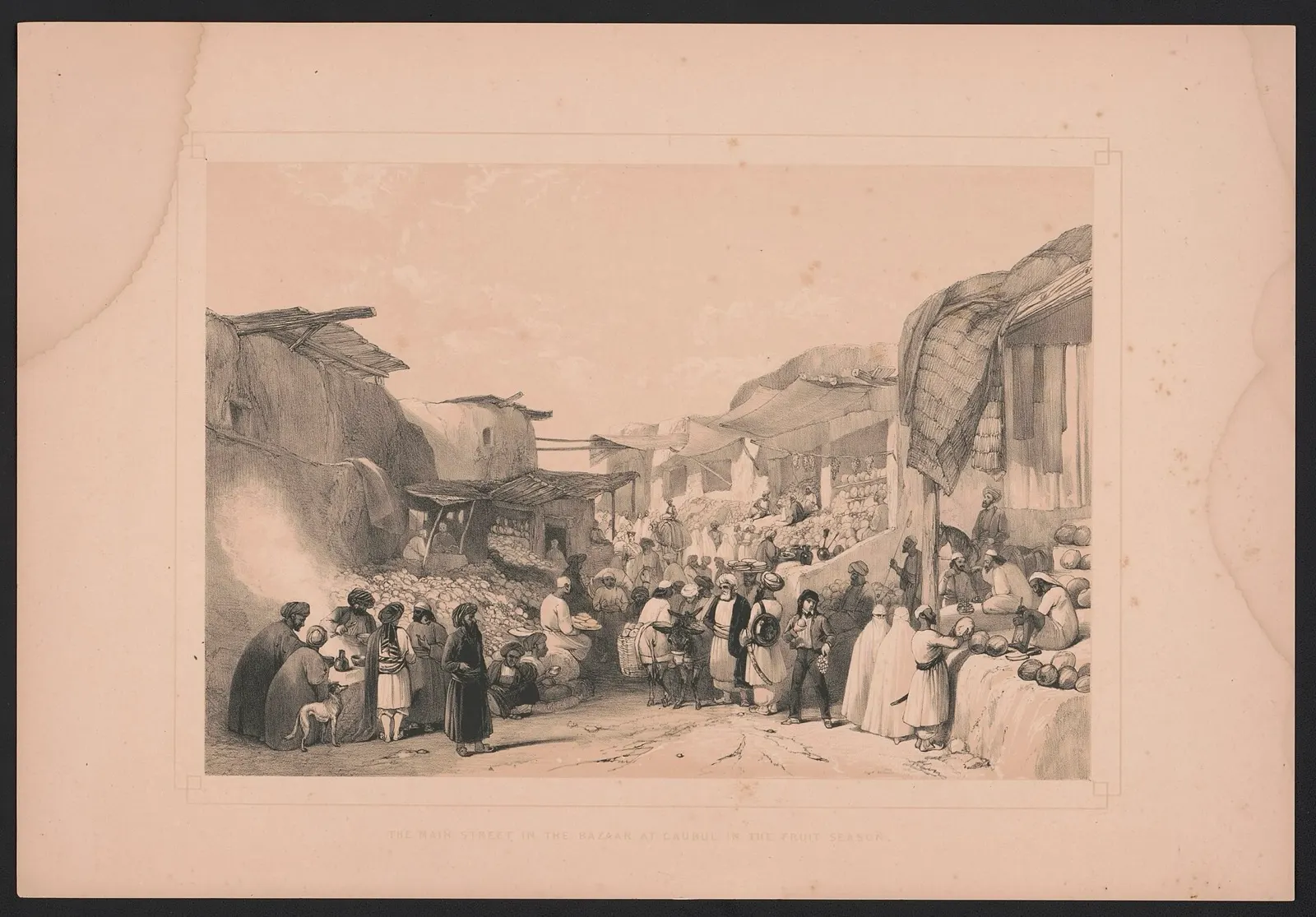
The main street in the bazaar at Caubul in the fruit season, lithograph by Louis and Charles Haghe after James Atkinson, 1842. Public domain, via the Library of Congress.
The traditional method is simple, and it's still used today. An inner metal drum holds the milk mixture. It sits inside a larger container packed with ice and salt, and the maker keeps twisting the drum against the ice so the mixture freezes onto its cold walls, scraping and working it until it sets. Some makers simply whisk cold milk by hand in a metal bucket set in ice, one batch at a time.
All that churning is hard work, and it gives shir yakh its dense, pulled texture. It also explains why it's sold fresh rather than stored.
In Afghanistan it was sold from dedicated ice cream shops, called shir yakh feroshi, which were busiest in the hot summer months. They were colorful places, decorated with tiles, selling ice cream and other cold desserts.2
Ice cream also meant spring. When the first ice cream cart of the year rolled through Kabul, jingle playing, it meant the season had turned.5
Faluda, firni and the rest of the Afghan sweet table
Shir yakh rarely shows up alone. In Afghanistan, faloodeh grew into faluda, a layered cold dessert that brings ice cream and noodles together. It's often served in a tall glass with rose syrup, noodles, ice cream, milk and nuts, sometimes over shaved ice with a spoonful of thick qaymaq cream, and it was sold in the same shir yakh shops. Recipes vary by family and by shop.
Then there's firni, the soft milk pudding that's a classic way to end an Afghan feast. It shares shir yakh's flavors: milk thickened with cornstarch, perfumed with cardamom and rosewater and finished with chopped pistachios. Firni is basically the warm-kitchen version of the same idea: milk, cardamom and rose, set by cooking instead of by ice.
Holidays belong to other sweets. Afghan bakers get their biggest orders for Nauroz and the two Eids, for treats like gosh-e-fil made especially to serve guests.6 Shir yakh is less a holiday dish than an everyday summer pleasure: the thing you stop for after school, or on a hot evening in the bazaar.
The Afghan diaspora and shir yakh today
Afghans who settled abroad, from Europe to Australia and North America, took shir yakh with them, often still churned by hand the old way. For many families it's a taste of home, and the handmade method is part of the point.
Getting Afghan ice cream in New York
That's the gap we wanted to fill. Cold Flower is two brothers, born and raised in New York, who couldn't find real Persian and Afghan ice cream in the city, so we learned to make it ourselves.
Our Shir Yakh is made with milk, sugar and cardamom in small weekly batches, with 100% Halal ingredients. Order online and we'll deliver pints across NYC and Long Island, or choose pickup in the East Village at checkout. Planning an event? We also bring our ice cream to parties and weddings with our ice cream cart catering.
Frequently asked questions
What is Afghan ice cream called?
Shir yakh, also spelled sheer yakh or sheeryakh. Shir is milk and yakh is ice, so the name means milk ice. The shops that sell it are known as shir yakh feroshi.
Is shir yakh the same as bastani?
They're close cousins from a shared tradition, but not identical. Bastani sonnati is Iran's classic saffron, rosewater and pistachio ice cream. Shir yakh is the Afghan name, and the versions sold in Kabul's shops and by Afghan makers abroad are usually flavored with cardamom or rosewater and churned by hand.
Is Afghan ice cream halal?
The traditional ingredients (milk, sugar, cardamom, rosewater and nuts) contain nothing haram, but commercial ice cream can include gelatin or alcohol-based flavorings, so check with the maker. Every Cold Flower pint, our Shir Yakh included, is made with 100% Halal ingredients.
Where can I buy Afghan ice cream in New York?
Cold Flower makes Shir Yakh in small weekly batches in New York. Order online for delivery across NYC and Long Island, or choose pickup in the East Village at checkout.
Taste it for yourself
Every pint is handmade in small batches with 100% Halal ingredients. When a batch sells out, it's gone until the next one.
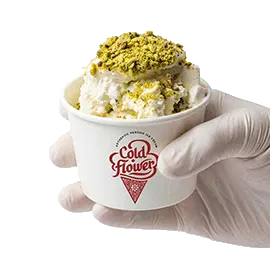
Shir Yakh
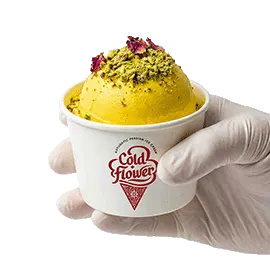
Bastani Sonnati

Saffron
Sources
-
F. Steingass, A Comprehensive Persian-English Dictionary (London, 1892), s.v. "yakh," Digital Dictionaries of South Asia, University of Chicago, https://dsal.uchicago.edu/cgi-bin/app/steingass_query.py?qs=yakh&searchhws=yes&matchtype=exact. ↩
-
Durkhanai Ayubi, "Flavors: Shir Yakheh Gulab (Rose and Pistachio Ice Cream)," AramcoWorld, 2023, https://www.aramcoworld.com/articles/2023/flavors-shir-yakheh-gulab-rose-and-pistachio-ice-cream. ↩ ↩2
-
Babur, The Babur-nama in English (Memoirs of Babur), trans. Annette Susannah Beveridge (London: Luzac, 1922), 1:215, https://archive.org/details/baburnamainengli01babuuoft/page/215/mode/1up. ↩
-
Hemming Jørgensen, "Yakhchal," Encyclopaedia Iranica, online edition, 2012, https://www.iranicaonline.org/articles/yakcal. ↩ ↩2
-
Kate Clark, "Sal-e Naw Mubarak! Neway kal-mu mubarak!," Afghanistan Analysts Network, 2013, https://www.afghanistan-analysts.org/en/reports/context-culture/sal-e-naw-mubarak-neway-kal-mu-mubarak/. ↩
-
"Cuisine: Afghan Sweet Delights," Dawn, 2018, https://www.dawn.com/news/1427585/cuisine-afghan-sweet-delights. ↩