What Is Saffron? History, Harvest and Its Place in Persian Ice Cream
· 7 min read
Saffron is the dried stigma of the saffron crocus, Crocus sativus: the three thin red threads at the center of each purple flower, picked by hand and dried. It takes very roughly 150,000 flowers to make a single kilogram, which is why saffron is the most expensive spice in the world and why a pinch is enough to turn a pot of rice, or a pint of ice cream, gold.
Saffron is the soul of Persian sweets, and our Saffron ice cream is built around it. So here is the whole story: what saffron is, how it's grown and harvested, where it comes from, how to tell real saffron from fake, and how it ends up in a scoop.
What is saffron, exactly?
Each saffron flower has six purple petals, three yellow stamens and a single style that splits into three long, deep red stigmas. The stigmas are the spice. The yellow style and stamens are not; they add little color or flavor, and in good saffron they're left out.
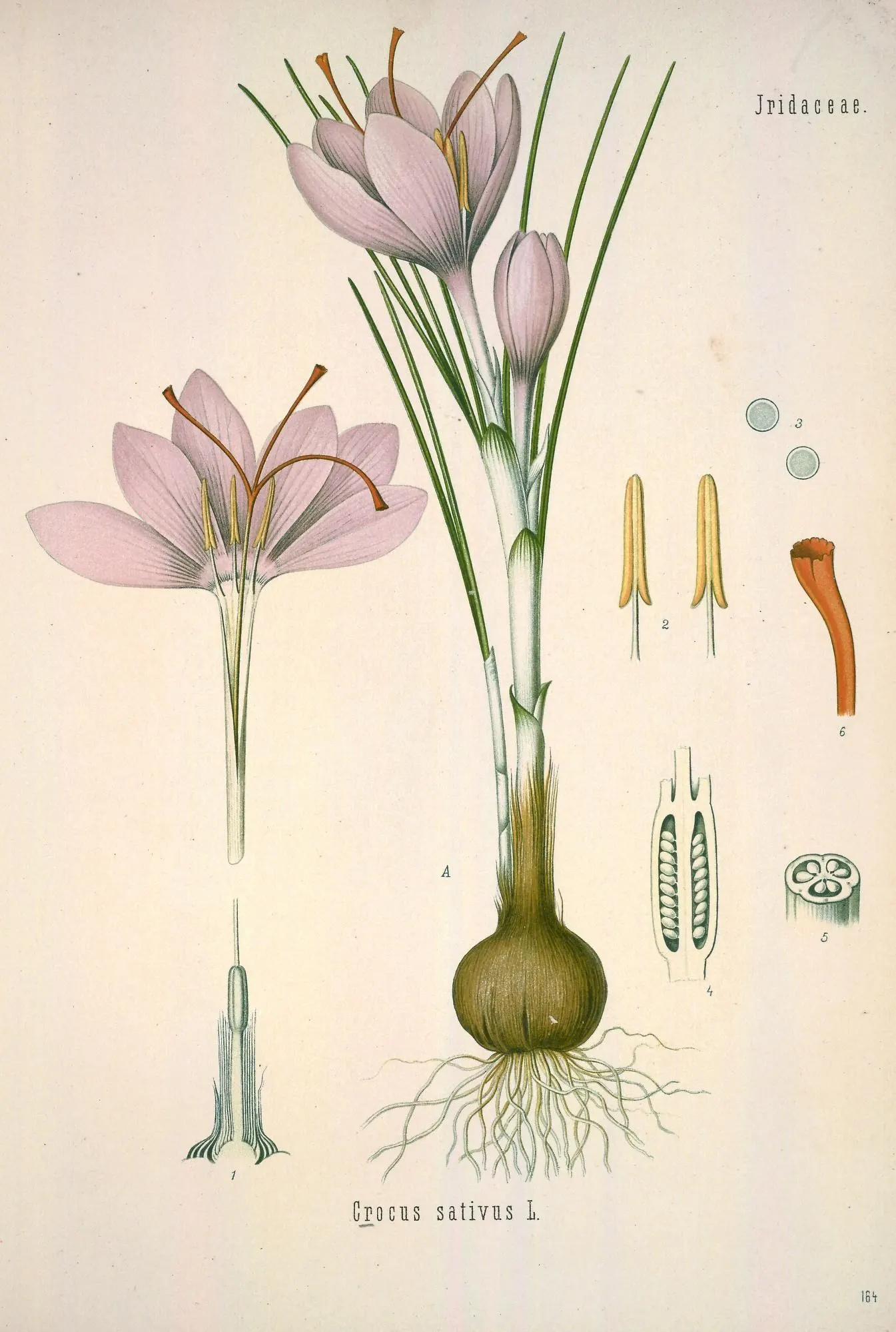
Crocus sativus, from Köhler's Medizinal-Pflanzen, 1890. Public domain, via Wikimedia Commons.
The plant has an unusual biology. Saffron crocus is a triploid: it carries three sets of chromosomes instead of two, which scrambles the way it forms pollen and egg cells and leaves it sterile. It doesn't set viable seed. Every saffron crocus on Earth is propagated by hand from corms, the bulb-like stems underground, which multiply into daughter corms that farmers dig up, divide and replant.1
That means saffron is, in a sense, one very old plant cloned over and over. Its DNA traces back to a wild crocus, Crocus cartwrightianus, and to Bronze Age Greece, where it first arose.
How is saffron harvested?
Saffron corms are planted in late summer and flower in autumn, usually from October into November, for a few short weeks. Each flower is at its best for only about a day, so the harvest is a race.
- Picking at dawn. Flowers are cut early in the morning, ideally before they fully open, so the stigmas aren't wilted by sun and heat.
- Separating by hand. Back indoors, the three red stigmas are pinched or snipped from each flower, one flower at a time. There is no machine that does this well.
- Drying. Fresh stigmas are mostly water and would rot within days. In Iran, India and Morocco they're traditionally dried at room temperature in the shade or sun. In Spain's La Mancha they're toasted in fine sieves over gentle heat, a quicker, hotter method that gives La Mancha saffron its own character.
The arithmetic is daunting. A kilogram of dried saffron takes somewhere between 110,000 and 200,000 flowers, usually put at about 150,000, and 370 to 470 hours of work: roughly 45 to 55 minutes to pick a thousand flowers, and another 100 to 130 minutes to separate their stigmas.2
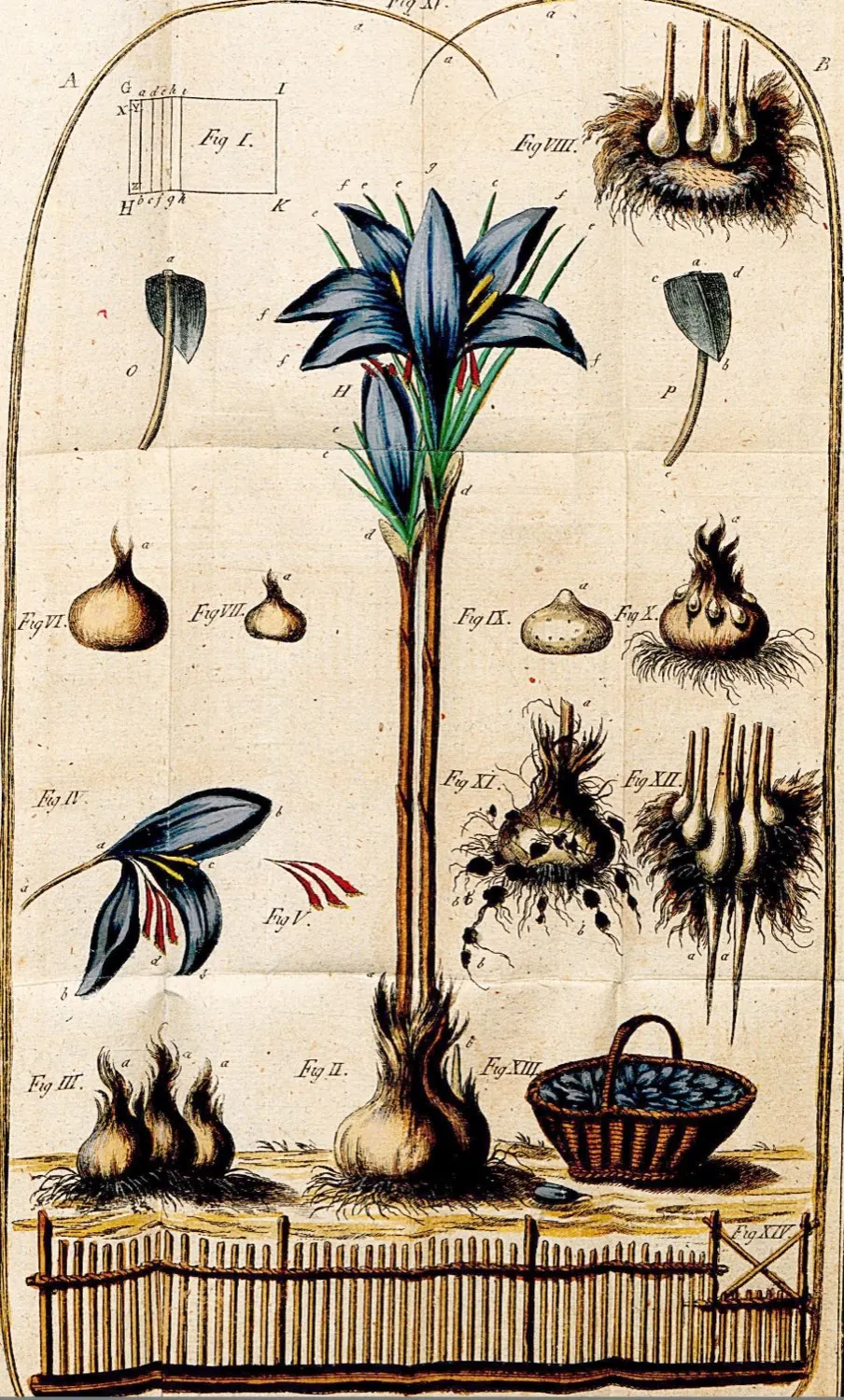
Plate from Ulrich Petrak's practical guide to growing saffron in Lower Austria, 1797, showing the flower, stigmas and the corms it grows from. CC0, via Wikimedia Commons.
Where does saffron come from today?
Today's main growing regions:
- Iran. By far the largest producer, growing around 90 percent of the world's saffron. Nearly all of it comes from the eastern provinces of Razavi Khorasan and South Khorasan, around towns like Torbat-e Heydarieh, Gonabad and Qaen.
- Afghanistan. Across the border, the Herat region grows most of Afghanistan's saffron, a crop that has expanded in recent decades.
- Kashmir. India's saffron comes almost entirely from the Kashmir Valley, from the karewa uplands of Pulwama district around Pampore. Kashmir saffron received a geographical indication tag in 2020.
- Spain. La Mancha saffron is protected as Azafrán de La Mancha, known for its toasting.
- Greece. Around Kozani in Macedonia, saffron (Krokos Kozanis) has had protected origin status since 1999 and is handled by a growers' cooperative.
- Morocco. The town of Taliouine and its neighbors, in the Anti-Atlas, grow most of Morocco's saffron.
Across these places, much of the harvest is done by women. In the saffron villages of Iran's Khorasan, women work at nearly every stage, especially picking and separating the stigmas, and in Herat most of the people separating stigmas are women.
A short history of saffron
Saffron has been cultivated for thousands of years, and it shows up in some of the oldest paintings in Europe.
- The Bronze Age Aegean. On the island of Thera (Santorini), the town of Akrotiri was buried in volcanic ash in the second millennium BCE, preserving its wall paintings. In a building archaeologists call Xeste 3, frescoes show young women gathering crocus flowers and offering them to a seated goddess. They're known as the "saffron gatherers" and date to roughly 1700 to 1500 BCE. No one knows for sure what the scene means: a coming-of-age rite, a healing goddess, or both.
- Ancient Persia. Saffron has been grown and traded across Iran for well over two thousand years, used as a dye, a perfume, a medicine and a seasoning. The English word comes, by way of Latin and French, from the Arabic za'farān, the same word Persian uses.
- Medieval trade. Saffron cultivation spread west with the Islamic world into Spain, where the word became azafrán, and from there across Europe. It was worth so much that it was smuggled, cut with fillers and stolen. In 1374, the story goes, nobles seized a large shipment of saffron bound for Basel, setting off a fourteen-week feud remembered as the "Saffron War".
Saffron grades and how to spot fake saffron
Because it is so expensive, saffron has always attracted fraud. The international standard ISO 3632 grades dried saffron in a lab by measuring three things in a water extract: coloring strength (crocins), bitterness (picrocrocin) and aroma (safranal). The best grade, Category I, needs a coloring strength above 200 on that scale, and the standard also caps moisture at 12 percent.3
The most common fakes and cuts:
- Other flowers passed off as saffron, especially safflower and marigold petals.
- Dyed fibers, like corn silk colored red.
- Yellow styles left attached or added to bulk up the weight.
- Powder cut with turmeric, paprika or synthetic dyes, which is why threads are safer to buy than ground saffron.
A few simple checks help. Real threads are all red with a slightly flared, trumpet-shaped tip. Dropped into water, real saffron releases a yellow-gold color slowly, over several minutes, while the threads stay red; a fake often bleeds red fast or turns pale. And if the price seems too good, it probably is.
The chemistry of saffron: color, taste and aroma
Three groups of compounds do almost all the work:
- Crocins give the color. They're carotenoids, related to the pigments in carrots, but unusually they dissolve in water, which is why saffron turns liquids gold so easily.
- Picrocrocin gives the taste: that slightly bitter, honeyed edge.
- Safranal gives most of the aroma. Little of it exists in the fresh flower; it forms mostly from picrocrocin as the stigmas dry, which is one reason drying methods matter so much.
That's also why good saffron smells sweet and hay-like, and why heat, light and air slowly dull it. Keep it sealed, dark and cool.
How saffron is used in Persian sweets and ice cream
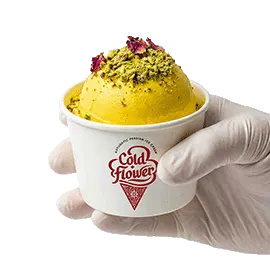
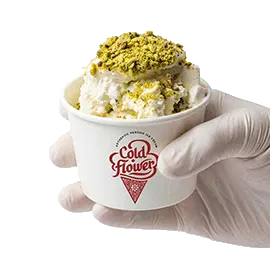
In Iran, saffron is everywhere: in rice, in stews, in tea, and above all in sweets. It colors sholeh zard, the saffron rice pudding scattered with cinnamon and almonds, flavors halva and syrups, and is the signature of bastani sonnati, Iran's classic saffron, rosewater and pistachio ice cream.
Persian cooks rarely drop threads straight into a dish. They bloom it first:
- Grind the threads to a powder, often with a pinch of sugar or a sugar cube, which helps them break down.
- Steep the powder in a little hot (not boiling) water, or rosewater, for several minutes. Some cooks set it over ice and let it melt slowly instead.
- Add the deep orange liquid to the dish near the end.
Blooming pulls the crocins, picrocrocin and safranal into the liquid so they spread evenly, and it means a small amount goes a long way. For ice cream, saffron's water-soluble color and its aroma carry beautifully into a cold, creamy base, and its faint bitterness balances the sugar. In our Saffron pint it's paired with a hint of rosewater. Our Bastani Sonnati adds pistachios and flakes of frozen cream. If you're curious how frozen desserts like this developed across the region, read our history of ice cream in the Middle East.
Getting saffron ice cream in New York
We're two brothers, born and raised in New York, who couldn't find real Persian and Afghan ice cream in the city, so we learned to make it ourselves. Saffron is at the heart of it.
We make our Saffron and Bastani Sonnati pints in small weekly batches, with 100% Halal ingredients. Order online for delivery across NYC and Long Island, or choose pickup in the East Village at checkout. Hosting a wedding, a Yalda night party, Nowruz or an Eid gathering? We bring the ice cream to you with our cart catering.
Frequently asked questions
Why is saffron so expensive?
Because almost every step is done by hand. Each flower gives only three stigmas, it takes very roughly 150,000 flowers to make a kilogram of dried saffron, and researchers estimate about 370 to 470 hours of picking and separating for that kilogram.
What does saffron taste like?
Honeyed, floral and a little earthy, with a faint bitterness at the edges. The bitterness comes from picrocrocin, the aroma mostly from safranal, and the golden color from crocins. Used sparingly it tastes warm and perfumed; too much turns it medicinal.
Is saffron a seed, a flower or a root?
None of those exactly. Saffron threads are the stigmas, the female part of the flower that catches pollen. The plant itself produces no viable seed, so it is grown from underground corms that farmers dig up, divide and replant.
Is saffron ice cream halal?
Saffron is a plant, so it is naturally halal, but commercial ice cream can contain gelatin or flavorings carried in alcohol, so check with the maker. Every Cold Flower pint, including our Saffron, is made with 100% Halal ingredients.
Where can I get saffron ice cream in New York?
Cold Flower makes Saffron and Bastani Sonnati ice cream in small weekly batches. Order online for delivery across NYC and Long Island, or choose pickup in the East Village at checkout.
Taste it for yourself
Every pint is handmade in small batches with 100% Halal ingredients. When a batch sells out, it's gone until the next one.
Saffron
Bastani Sonnati
Shir Yakh
Sources
-
Seyyedeh-Sanam Kazemi-Shahandashti et al., "Ancient Artworks and Crocus Genetics Both Support Saffron's Origin in Early Greece," Frontiers in Plant Science 13 (2022), https://www.frontiersin.org/articles/10.3389/fpls.2022.834416/full. ↩
-
T. S. Cid-Pérez et al., "The Relation between Drying Conditions and the Development of Volatile Compounds in Saffron (Crocus sativus)," Molecules 26, no. 22 (2021): 6954, https://pmc.ncbi.nlm.nih.gov/articles/PMC8621395/. ↩
-
Stella A. Ordoudi and Maria Z. Tsimidou, "Building a Database for the Quality Characteristics of the Protected Designation of Origin Saffron Krokos Kozanis, Considering International Trade Requirements," Exploration of Foods and Foodomics 2, no. 3 (2024): 236–51, https://explorationpub.com/Journals/eff/Article/101036. ↩